

Cherokee Nation
A Heritage of Self-Governance
By: Keith Austin | Category: Education | Issue: November 2026
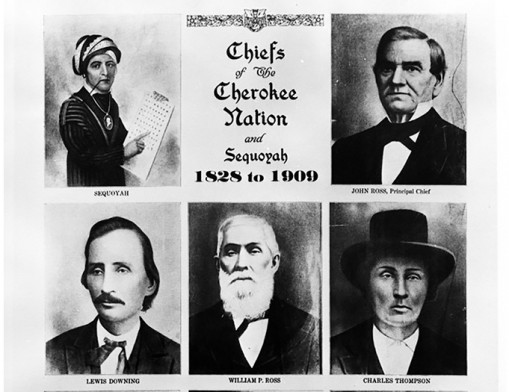
Sequoyah and Cherokee Chiefs, photograph, 1829~/1909~; (https://gateway.okhistory.org/ark:/67531/metadc1620637/: accessed October 19, 2026), The Gateway to Oklahoma History, https://gateway.okhistory.org. Photo courtesy of the Oklahoma Historical Society, public domain.
November is Native American Heritage Month, a time to recognize the histories and cultures of Native peoples. For the people of the Cherokee Nation, it is an opportunity to reflect on an essential part of our heritage: the right and responsibility to govern ourselves. Our sovereignty is not simply a part of our history; it is a living tradition we carry forward.
What I know about self-governance comes not only from books but also from my Cherokee grandparents, Orie and Alice Callison. Grandad was born in 1907, two weeks after Oklahoma became a state, and Grandma was born in 1911. With statehood came the denial of the Cherokee people’s right to choose their own leaders. My grandparents were both more than 60 years old before this right was restored to the Cherokee people.
When I was a child, my grandmother taught me that the Cherokee Nation would not experience prosperity until our people could once again manage our own affairs. I came to understand that she was talking about more than economic prosperity. She was talking about the dignity of our people and the freedom to shape our own future through representative self-governance. That lesson has stayed with me throughout my life.
Cherokee Nation Self-Government
As we observe Native American Heritage Month, the lesson of my grandparents reminds me that our heritage is not limited to our language, arts and traditions. It also includes our history of self-government.
Before the Cherokee people were removed from their homelands, and long before Oklahoma became a state, we had an organized system of government. In 1827, we established a written constitution. Through this constitution, our ancestors adapted their traditional institutions to changing realities while preserving their identity and nationhood.
Forced removal, the Trail of Tears, the loss of our homelands and federal efforts to diminish tribal authority tested our Nation. Yet the Cherokee people endured. We continued working to preserve our culture and restore our ability to govern ourselves.
Loss and Restoration in the Cherokee Nation
Oklahoma statehood in 1907 brought another difficult chapter. Cherokee citizens lost the ability to choose their own Principal Chief through an election, and the position was filled through federal appointment.
In 1970, Congress took an important step toward restoring that right. The Principal Chiefs Act, signed by President Richard Nixon in 1970, had passed the U.S. Senate unanimously. It provided for the restoration of elections for principal chiefs of the Five Tribes of Oklahoma. In 1971, Cherokee citizens once again went to the polls to select their Principal Chief.
My grandparents lived to see that restoration. Their generation experienced the loss of a fundamental right and witnessed its return. Their lives, and those of others in their generation, remind us that the freedoms we exercise today were not always available to our people.
The Cherokee people continued rebuilding our constitutional government, adopting a new constitution in 1976 and ratifying our current Constitution in 2003. Beginning with the words “We, the People of the Cherokee Nation,” our Constitution guides us as we exercise sovereignty.
The Cherokee Constitution
It clearly distributes authority among three branches of government. The Principal Chief and Deputy Principal Chief lead the executive branch, while the 17-member Tribal Council serves as the legislative branch. The judicial branch interprets and applies the law. The executive administration and Tribal Council are co-equal branches with distinct responsibilities, providing checks and balances that help protect the interests of the Nation and its citizens.
Our Constitution also provides the framework for choosing our leaders. Elections allow Cherokee citizens to determine who will represent them.
In 2027, Cherokee citizens will again have the opportunity to elect a Principal Chief, Deputy Principal Chief and eight of the 17 Tribal Council members. The election will help shape the future of our Nation.
This is sovereignty in action. Our ancestors fought to preserve a nation in which Cherokee people could determine their own affairs. Today, we honor their legacy by participating in elections and remaining engaged with our government.
Native American Rights Bring Responsibility
During Native American Heritage Month, we celebrate the people who came before us and the traditions we inherited from them. We should also recognize the responsibility that comes with the rights they helped restore. Our sovereignty is something we practice every day.
My grandmother taught me that a nation must have the ability to manage its own affairs if it is to reach its full potential. As we approach the 2027 election, I encourage Cherokee citizens to remember that lesson and exercise the rights our ancestors worked so hard to restore.
November is a time to honor our heritage. Participating in our Nation’s elections is one meaningful way to express it—not only by remembering our history but also by taking responsibility for what comes next.
Self-governance is our heritage. Voting is one way we keep it alive for future generations.

Keith Austin, historian and author
For more information, contact:
Keith Austin
(918) 508-9116
eat0@eau0eav0eaw0
OK
More about Keith Austin, historian and author:
More Articles
Subscribe
For Free!