
America At 250 And The Cherokee Nation
Cherokee Nation History
By: Keith Austin | Category: Education | Issue: August 2026
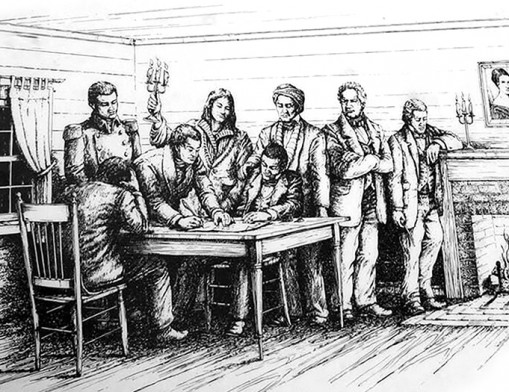
Image of the signing of the Treaty of New Echota. Photo courtesy of Keith Austin, public domain, July 2026
As the United States approaches the America 250 celebration, Cherokee people reflect on this anniversary from a perspective far older than the founding of the United States itself.
For the Cherokee Nation, our history did not begin with the Declaration of Independence in 1776.
Long before the American Colonies declared their independence from Great Britain, the Cherokee people governed themselves on land they had lived on for centuries before the United States became a nation.
Celebration and Contradiction
When America celebrates 250 years, Cherokee people recognize both the opportunities for celebration and the contradictions within that history.
The relationship between the Cherokee Nation and the United States has largely been shaped through treaties. The United States entered treaty relationships with the Cherokee Nation because it recognized the Cherokee Nation as a sovereign government.
Those treaties are not historical footnotes. Under the United States Constitution, treaties remain part of the supreme law of the land.
At the same time, the reality is that many treaty promises were broken.
The nineteenth century was heavily influenced by Manifest Destiny, the belief that the United States was destined to expand westward. To many Americans, expansion represented opportunity and progress. For Native nations, it often meant the loss of homelands, disruption of traditional ways of life, and the sacrifice of self-determination.
The most devastating example for the Cherokee people came during the 1830s. Despite treaty guarantees and victories confirming their sovereignty before the United States Supreme Court, the Cherokee people were forcibly removed from their homelands during the Trail of Tears. Twenty-five percent of the Cherokee population died during the journey west.
Self-Governance and Restored Rights
Instead of fading into history, the Cherokee Nation rebuilt.
The Nation established schools, courts, and a constitutional government in present-day Oklahoma. That progress was later disrupted by the Dawes and Curtis Acts, which weakened tribal governments. With Oklahoma statehood in 1907, Cherokee self-governance entered a period of severe federal restriction.
Yet Cherokee self-government never fully disappeared.
Cherokee leaders, communities and families preserved culture, identity, and traditions even during the hardest years.
During the twentieth century, the Cherokee Nation gradually regained greater authority through the modern era of self-determination. President Richard Nixon’s support for tribal self-governance marked an important turning point in federal Indian policy. The Principal Chiefs Act restored the right of Cherokee citizens to elect their own Principal Chief rather than having chiefs appointed by the federal government.
“A republic, if you can keep it.”
After the United States Constitutional Convention, Benjamin Franklin was asked what kind of government had been created. He famously replied, “A republic, if you can keep it.”
The Cherokee experience reflects that same challenge. For generations, Cherokee people fought to keep their government, sovereignty, and national identity alive despite removal, allotment, statehood, and federal policies designed to weaken tribal self-rule. That restoration of self-governance remains one of the great stories of Native resilience in modern America.
Today, the Cherokee Nation is legally recognized as a domestic dependent sovereign. The Cherokee Nation is not a foreign country, but neither is it simply another local government. Cherokee sovereignty predates the United States itself and its people are full citizens of both the Cherokee Nation and the United States.
The history between the Cherokee Nation and the United States includes difficult truths. Like much of the United States during the nineteenth century, the Cherokee Nation participated in slavery. Following the Civil War, treaties recognized the rights of Cherokee Freedmen. Yet it took nearly 140 years for the Cherokee Nation to fully affirm the citizenship rights of Freedmen descendants.
Unresolved Tensions
Another unresolved issue remains the promise of a Cherokee delegate to the United States House of Representatives. The Treaty of New Echota in 1835 promised the Cherokee Nation the right to send a delegate to Congress. Nearly two centuries later, that promise remains unfulfilled.
Yet despite the tensions in that history, Cherokee people have consistently served in defense of the United States. Native Americans serve in the armed forces at a higher per capita rate than any other ethnic group. Cherokee men and women have fought in every major American conflict.
The United States and the Cherokee Nation are strengthened by diversity. Different cultures and traditions make both nations stronger, more resilient, more interesting, and more beautiful. Diversity is not something to fear. It is one of our greatest strengths.
Memory and Optimism
As America marks 250 years, Cherokee people carry both memory and optimism forward. We remember the treaties. We remember the broken promises. We remember removal. But we also recognize extraordinary progress.
Today the Cherokee Nation is the largest tribal nation in the United States, with a growing economy and expanding healthcare. The Cherokee Nation also has a thriving effort to preserve and promote its culture, language and history, and a dedication to educating their youth for a better future.
America at its best strives to become more just, more inclusive, and more faithful to its ideals. The same can be said of the Cherokee Nation.
As the United States turns 250, the Cherokee Nation moves forward grounded in history, committed to sovereignty, and hopeful about the future. Neither nation has ever been perfect, but perhaps the true measure of both is the willingness to continue striving together to become more perfect nations.
Keith Austin, historian and author
For more information, contact:
Keith Austin
(918) 508-9116
eat0@eau0eav0eaw0
OK
More about Keith Austin, historian and author:
More ArticlesSubscribe
For Free!