
Route 66 and the Cherokee Nation
One Hundred Years of Stories
By: Keith Austin | Category: Special Interest | Issue: June 2026
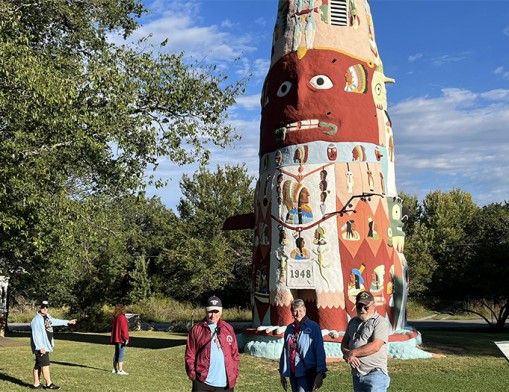
The Foyil Totem Pole Park, created by Ed Galloway. Photo courtesy Keith Austin, May 2026.
If you come into the Cherokee Nation on Route 66 from the east, one of the first things you’ll see is the Cherokee Nation Anna Mitchell Cultural & Welcome Center. Sitting a little higher than everything else around it, it’s not just a place to get souvenirs—it is also a reminder that you are entering a place with its own history and its own Route 66 story.
You are in the Cherokee Nation
In honor of this unique story the Anna Mitchell Cultural and Welcome Center will be hosting a new exhibit entitled “Path of Resilience: A Century of Route 66 in Cherokee Nation”. The exhibit will run from May 14, 2026 – February 7, 2027.
Come from the west, and your first impression is very different. The Hard Rock Hotel & Casino Catoosa greets you with Cherokee hospitality and one of the most beautiful golf courses in Oklahoma. Every October the Hard Rock hosts the Cherokee Art market, one of the most prominent Native American art shows and sales in the United States.
Despite their differences, both places tell you the same thing: you are in the Cherokee Nation—a place that is not frozen in history, but a place alive and still making history.
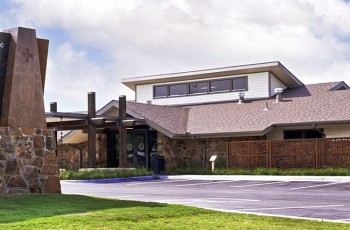
The Anna Mitchell Cultural and Welcome Center. Photo Courtesy visitcherokeenation.com, May 2026.
And that is exactly what Route 66 has always been in the Cherokee Nation—not just a road, but a connection to a living story.
As you travel the road in the Cherokee Nation, you begin to notice something else: the names along the way are not random.
Bushyhead carries the name of Cherokee Chief Dennis Bushyhead. Vinita connects to leaders of the Cherokee Nation like Thomas Buffington and today’s Principal Chief, Chuck Hoskin Jr.. Chelsea proudly remembers Cherokee Chief J. B. Milam and Jerry Douglas, former Chief of our sister tribe, the Delaware Nation.
Claremore carries a layered history. Claremore’s name actually comes from an Osage Chief—reflecting the interwoven histories of the Native nations in this region. While its main crossroads are Route 66 and Highway 88 which are known locally as Lynn Riggs Blvd in honor of the Cherokee playwright and Will Rogers Blvd whose namesake is local legend Will Rogers, the Cherokee Kid.
Even the land itself tells stories. Just off the road near White Oak, the story of the Cherokee Nation intersects with its sister tribe, the Shawnee Tribe. Here, the Shawnee cultural grounds host gatherings, ceremonies, and community events, reminding travelers that Route 66 passes through land where traditions continue to thrive side by side.
And Catoosa carries its Cherokee heritage too—the name comes from a Cherokee word meaning “on the hill.”
As you move along Route 66, you are moving through chapters in the story of the Cherokee Nation.
The Will Rogers Highway
Will Rogers spent much of his life traveling between Oklahoma and California on Route 66. He met people everywhere he went—from movie stars, royalty, and politicians, but mostly everyday folks—and he had a way of cutting through differences with humor and humility.
“I never met a man I didn’t like,” he once said.
On Route 66, that wasn’t just a saying—it was a reality.
Because this road brought people together. It made possible encounters that might never have happened otherwise. Strangers sat at the same cafés, stopped at the same gas stations, and shared the same stretches of open road. And in those moments, something powerful happened: people met each other, and the world became smaller.
The Bunion Derby
Some of the stories that traveled this road are almost hard to believe.
In 1928, when Route 66 was very young, over 300 runners set out on a race that would stretch coast to coast—from Los Angeles to New York City, nearly 3,500 miles, much of it on Route 66. They called it the Bunion Derby.
Among them was a young Cherokee man from Foyil—Andy Payne.
Nobody expected him to be the favorite to win. He didn’t train in any formal way—he simply ran the roads of Rogers County, Oklahoma. But when the race came through his home territory along Route 66, something changed.
Thousands of people came out to watch. To cheer. To support one of their own.
One step at a time, and one mile at a time, Payne outran and outlasted competitors from across the country and around the world. When he won, he won more than a prize—he won the hearts of not only the Cherokee Nation, but all of Oklahoma as well.
The Road West
Not every journey along Route 66 was about victory.
During the Great Depression, the road became a path of survival. Families loaded everything they owned into cars and trucks and headed west, fleeing the Dust Bowl and seeking a way to earn a living.
Many of them came from Oklahoma. Some were Cherokee.
For those families, the road west carried century-old memories of their ancestors—the Trail of Tears.
This time, soldiers didn’t force them onto the road. But economic reality did.
Once again, they were heading west, leaving home behind in search of something uncertain.
A Road Out—and Back
That movement west did not end with the Depression.
A generation later, under federal relocation programs, Native families were encouraged to move to cities like Los Angeles. Among them was the family of Wilma Mankiller.
As a young girl, she left the Cherokee Nation for California.
No one can say exactly which roads they traveled, but it is hard to imagine that Route 66 was not part of that journey.
What matters even more is that she came back.
And when she returned, she brought with her a determination to serve her people. She would go on to become the first woman elected Principal Chief of the Cherokee Nation.
Her story reflects something essential about Route 66.
It was not only a road out.
It was also a road home.
Encounters Along the Road
As the years passed, the road carried more than migrants and runners—it carried visitors.
At first from across the country… and eventually, from around the world.
For many of them, passing through the Cherokee Nation was their first real encounter with Native people—not a story in a book, not an image on a screen.
And those moments mattered.
They challenged assumptions. They showed that Cherokees did not live in teepees and were, in most ways, modern people. They replaced stereotypes with reality.
As Will Rogers once put it, “A stranger is just a friend I haven’t met yet.”
Route 66 introduced a lot of strangers to the Cherokee Nation—it helped build understanding, one meeting at a time.
Art and Misunderstanding
But not everything travelers learned along the road was accurate.
Just outside Foyil stands the Foyil Totem Pole Park, created by Ed Galloway.
It is one of the most recognized examples of American roadside art anywhere along Route 66.
But there is an important truth behind it.
Ed Galloway was not Cherokee, and as far as we know, he was not a member of any Tribal Nation. The totem pole he created does not come from Cherokee tradition.
While it stands in the middle of the Cherokee Nation, it is not a piece of Cherokee history—it is an interpretation, a work of art shaped by one man’s understanding of generic Native culture.
However, some travelers came to see it differently. For them, the story it told was history.
And that reveals something important about Route 66.
The road carried truth.
But it also carried misunderstanding.
Sometimes both at the same time.
A Living Road
Today, Route 66 still runs through the Cherokee Nation, carrying travelers along the same path.
But if you look closely, you’ll see that it carries something more.
It carries the memory of runners chasing dreams…
families searching for survival…
and leaders who left—and came back—to shape the future of their people.
It carries conversations between strangers.
And maybe that is the most important part of the story.
Route 66 did more than connect places.
It connected people.
And here in the Cherokee Nation, it still does.
For questions about Visit Cherokee Nation, or to book a tour, please contact by calling 877.779.6977, or email: eat1@eau1eav1eaw1

Route 66 in the Cherokee Nation is a Value News and Green Country Tourism Premier Place.
Keith Austin, historian and author
For more information, contact:
Keith Austin
(918) 508-9116
eat0@eau0eav0eaw0
OK
More about Keith Austin, historian and author:
More ArticlesSubscribe
For Free!